

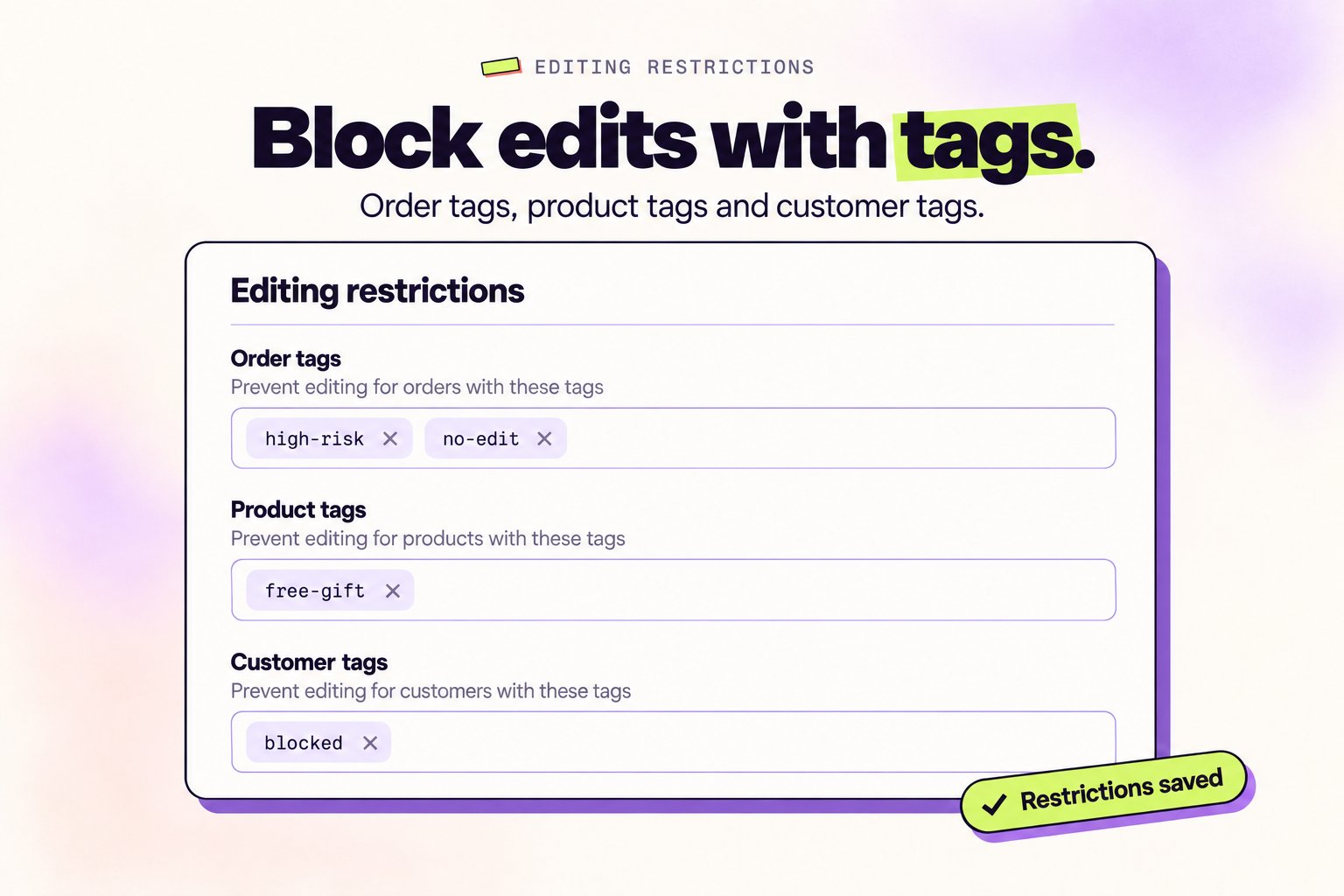
Use order tags, product tags, and customer tags to block edits. Leave a field blank to allow edits on everything. To hide only some features instead of blocking the whole order, use feature visibility rules.
Set it in the app
1
Open Settings
In the Revize app, click Settings in the sidebar, then open the Order editing tab. The first section is Editing restrictions.
2
Add blocking tags
Type a tag under Order tags, Product tags, or Customer tags and press Enter. Add as many tags as you need, then click Save.
3
Tag in Shopify
Add these same tags to your orders, products, or customers in Shopify. Revize reads them automatically and blocks edits.
How it works
Revize doesn’t place its fulfillment hold on orders that are blocked by an order tag or a customer tag. If you add a blocking order tag after checkout, Revize releases its hold on that order.
Where to find tags in Shopify
For orders:- Go to Orders in your Shopify admin
- Click on any order
- Find the Tags field on the order page
- Add tags like
no-editorhigh-risk
- Go to Products in your Shopify admin
- Click on any product
- In the Product organization section, find Tags
- Add tags like
final-saleorcustom
- Go to Customers in your Shopify admin
- Click on any customer
- Find the Tags field on the customer page
- Add tags like
no-editorfraud
Feature visibility rules
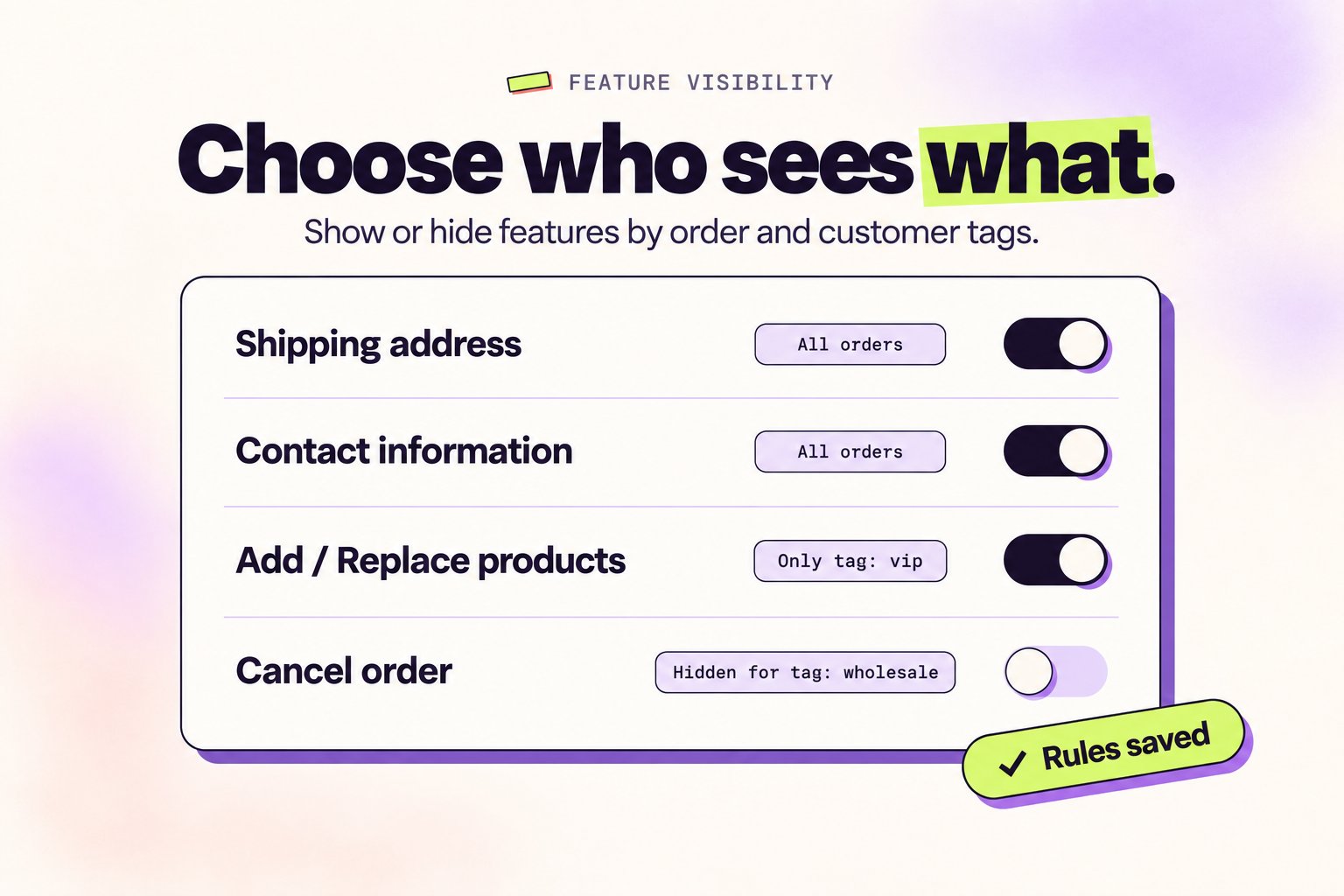
Feature visibility rules let you show or hide individual editing features based on order tags and customer tags. The rest of the order stays editable. For example, hide Cancel order on wholesale orders but still let those customers change their shipping address.Feature visibility rules depend on your plan. If your plan doesn’t include them, the section is locked and shows an Upgrade plan button.
Create a rule
1
Open feature visibility rules
In the Revize app, go to Settings → Advanced → Feature visibility rules.
2
Add a rule to a feature
Find the feature you want to control and click Add rule. Click the arrow next to the new rule to open it.
3
Name the rule and pick an action
Enter a Rule name, then set Action to Show feature or Hide feature.
4
Set the primary condition
Under Primary condition, choose:
- Target: Order or Customer tags
- Match: Contains or Not Contains
- Logic: All (AND) or Any (OR) of the tags
5
Add more conditions (optional)
Click Add condition to check more order or customer tags. Use Combine with primary to decide whether the primary condition and the extra conditions must both match (All (AND)) or either one is enough (Any (OR)). With two or more conditions, Combine multiple conditions sets how they combine with each other.
6
Turn the rule on and save
New rules start switched off. Turn on the toggle next to the rule name, then click Save. Every active rule needs at least one tag in each condition, or the rule can’t be saved.
Features you can control
- Shipping address
- Contact information
- Add products
- Replace products
- Edit product details
- Cancel order
- Apply discounts
- Tax invoice
- Support ticket
- Shipping method
- Delivery date
- Custom note
How rules combine
- No active rules: the feature shows as usual.
- Hide wins: if any active Hide feature rule matches, the feature is hidden, even when a Show feature rule also matches.
- Show rules act as an allow list: if a feature has active Show feature rules, it appears only when at least one of them matches. Everyone else doesn’t see it.
- Tag matching ignores letter case, so
VIPandvipare the same tag.
- Hide Cancel order when the order contains the tag
wholesale - Hide Shipping address when the customer contains the tag
fraud - Show Shipping method only when the customer contains the tag
vip
Restrictions our team configures
For these restrictions, contact us and we’ll set them up for you:Curated add-products
Show only specific products when customers try to add items to their order.
Custom property blocks
Block edits based on custom line item properties like bundle IDs or special flags.
Best practices
Use clear tag names:no-editinstead ofneorblockfinal-saleinstead offsorclearancehigh-riskinstead ofhrorrisky
- Decide which products should never be editable and tag them when you create them
- Use Shopify Flow to automatically tag orders based on value, location, or customer type
- Document your tags so your team knows what each one does
Common questions
I added a tag but the order is still editable
I added a tag but the order is still editable
Check these things:
- Make sure the tag name in Revize is spelled the same as the tag in Shopify (letter case doesn’t matter)
- Click Save in Revize after adding the tag
- Check if you added the tag to the right place (order, product, or customer)
- Refresh the customer’s order page and try again
Only one product is blocked but customers can still edit the order
Only one product is blocked but customers can still edit the order
This is normal. Product tags only block that specific product. Customers can still edit other items in the same order.If you want to block the entire order, use an order tag instead.
Can I hide one feature instead of blocking the whole order?
Can I hide one feature instead of blocking the whole order?
Yes. Use feature visibility rules to hide a single feature, like Cancel order or Shipping address, for orders or customers with specific tags.
Can I block editing after a certain time?
Can I block editing after a certain time?
Yes, with Shopify Flow. Set up a Flow that adds a
no-edit tag to orders 2 hours after they’re created. Then add no-edit to your order tag block list in Revize.I need a restriction that's not available
I need a restriction that's not available
Email us! Send your requirements to hello@revize.app. We can set up custom rules for almost any scenario.
How do I automate tag blocking with Shopify Flow?
How do I automate tag blocking with Shopify Flow?
Set up automatic tagging to block edits based on your business rules:Example workflows:
1
Add blocking tags to Revize
First, add your blocking tags in Revize under order tags or product tags (like
no-edit or high-risk).2
Create a Shopify Flow
In Shopify, create a Flow that adds these same tags to orders or products based on your conditions.
3
Edits get blocked automatically
When Flow adds the tag to an order or product, Revize automatically blocks editing.
- Add
no-editto your order tag block list → Create a Flow that tags orders withno-edit2 hours after they’re placed - Add
high-riskto your order tag block list → Create a Flow that tags orders over $500 withhigh-risk - Add
final-saleto your product tag block list → Create a Flow that tags clearance products withfinal-sale
The tags you set up in Revize and the tags Flow adds to orders or products must match exactly for blocking to work.
Related setup
- Edit window: set how long customers can edit orders
- Rules engine: set editing deadlines and actions for specific orders
- Order processing: choose hold vs skip-hold workflow
- Customer edit options: control what types of edits are allowed