Create targeted Shopify post-purchase upsell offers on the Thank-you and Order-status pages. Choose products, discounts, layouts, countdowns, schedules, and measure captured revenue.
Post-purchase Upsells let customers add multiple products to an order they have already placed. Revize adds them to the same Shopify order, Shopify collects only the difference, and everything ships together.
Revize gives you three product-addition experiences. They work together, but they solve different jobs.
Upsell offers
You are here. Proactively recommend products on the Thank-you and Order-status pages. You control the audience, product source, discount, layout, timing, and priority.
Add products
Let customers open the Revize Customer Portal and search or browse products when they already know what they want to add.
Email upsells
Put one-click Add to Order links in your post-purchase email and SMS flows.
This guide focuses on Upsell offers, the rule-driven offer engine available on the Pro plan.
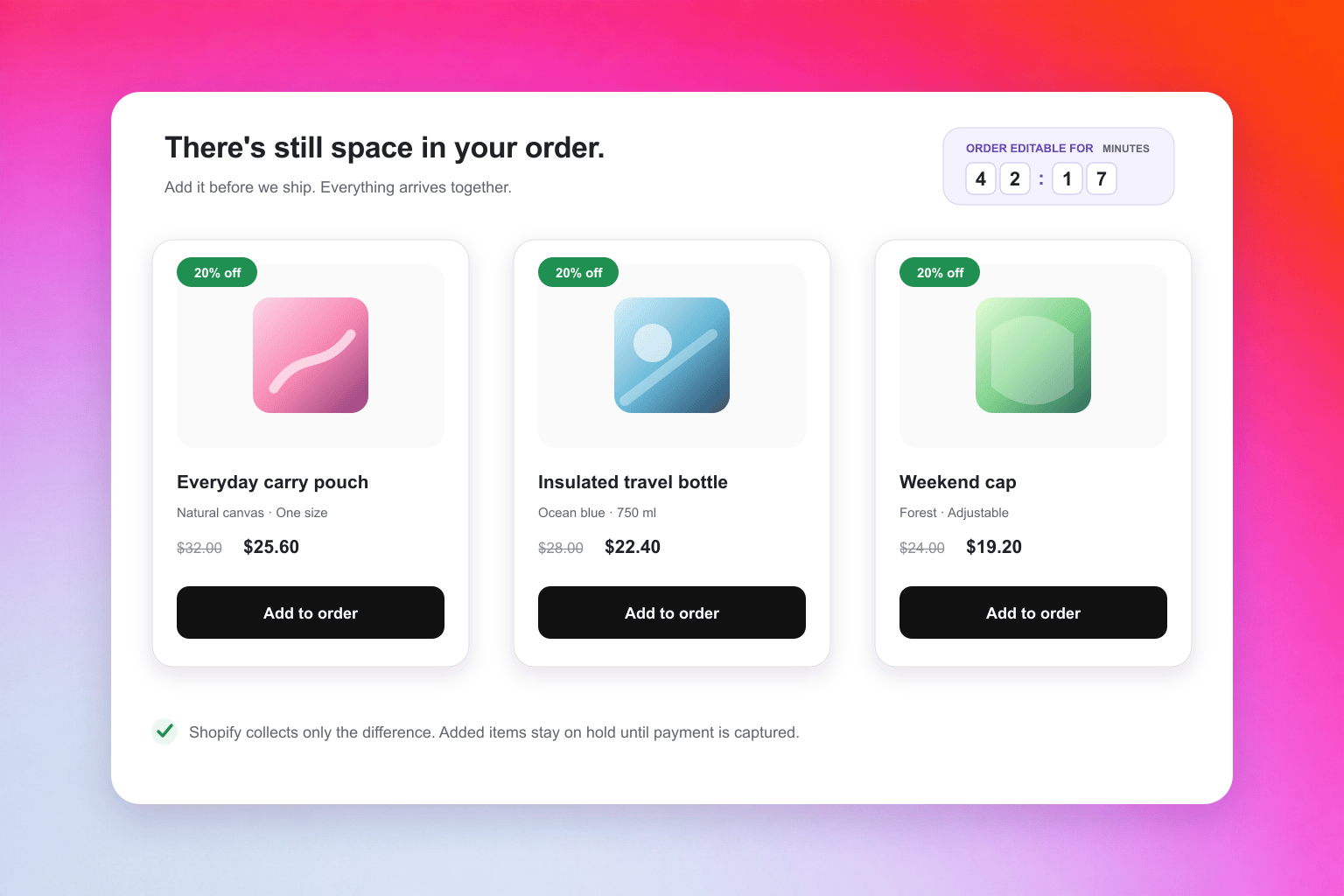
When a customer opens the Thank-you or Order-status page, Revize checks your active offers from top to bottom and shows the first one whose conditions match the order.
2
The customer chooses a product
The offer displays products in your selected layout, with the discount, countdown, variants, quantity, and Add to order button.
3
Revize edits the existing order
The selected item is added through Shopify order editing. There is no second cart and no separate order.
4
Shopify collects the difference
Shopify recalculates the amount due and handles the additional payment. The added item stays on fulfillment hold until payment is captured, except for cash-on-delivery orders.
Payment always stays in Shopify’s native flow. After the item is added, Shopify recalculates the amount due and lets the customer review and pay for the updated order. Revize does not create a side checkout or send a manual invoice for the upsell.
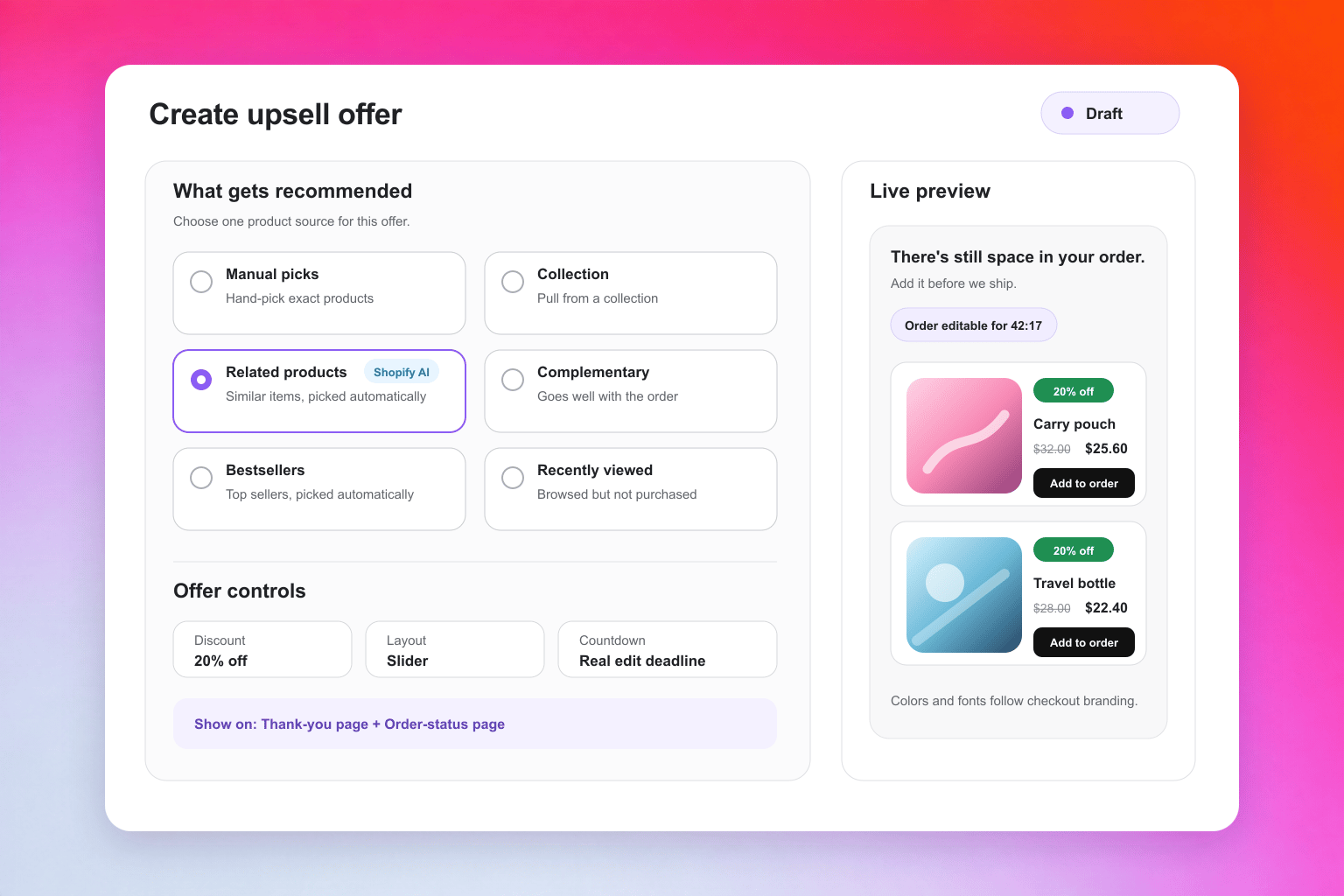
Open Upsell in the Revize app and click Create offer. New offers start as Draft, so nothing appears to customers until you set the status to Active and save.
1
Name the offer and choose its surfaces
Give the offer an internal name, then show it on the Thank-you page, Order-status page, or both.
2
Add trigger conditions
Target specific orders or customers. Leave the conditions empty to show the offer on every eligible order.
3
Choose the products
Pick one of the six product sources below, then set fallbacks and inventory safety.
4
Configure the incentive and design
Add an optional discount, choose a layout, customize the copy, and enable an honest countdown tied to the order-editing deadline.
5
Schedule and activate
Set a start and end date if needed, choose how often the offer can be accepted, change the status to Active, and save.
Turn on Fall back to bestsellers to keep the offer visible when the selected source has no eligible products.Recently viewed offers can also fall back to related products when the shopper has no browse history.
Inventory safety
Choose one of three inventory rules:
Skip products that are out of stock
Skip products with fewer than 5 units in stock
Show products regardless of stock
Hide products already purchased
Enable Hide products already in the order when you never want to recommend an item the customer just bought.
With no conditions, the offer is eligible for every order. Add conditions when the offer should appear only for a particular order or customer segment.
Condition
Example
Order tags
Show a wholesale add-on only when the order has b2b
Order total
Show a premium accessory above $100
Item count
Show a small add-on for one-item orders
Order contains product
Recommend refills when the starter kit is present
Payment method
Create different offers for prepaid and manual payment orders
Shipping country
Limit an offer to countries you can fulfill quickly
Customer tags
Give VIP or wholesale customers a dedicated offer
First-time buyer
Introduce a popular add-on after the first purchase
Returning customer
Show a loyalty-focused offer
Lifetime spend
Reserve a premium offer for high-value customers
Order placed during
Run an offer only during selected hours
Conditions sit inside groups with ALL or ANY matching. Groups can also be combined with ALL or ANY, so you can express logic such as:(VIP customer) OR (order total above 150 AND shipping country is US)
Revize re-checks the conditions on the server when the customer accepts the offer. An outdated page cannot bypass your targeting rules.
Edit the Heading, Subheading, and Button text per offer. Leave them blank to use Revize’s built-in translated defaults.Two dynamic tokens are available:
[discount] inserts the offer discount, such as 20%
[duration] inserts the remaining offer time
Colors and fonts inherit the store’s Shopify checkout branding automatically.
The countdown is optional and configured per offer.
Order editing deadline
Custom countdown
Counts down to the real moment the order locks for editing. This is the recommended mode because the urgency matches the customer’s actual last chance to add an item.
Starts a fixed duration when the customer first sees the offer. A custom countdown never runs past the real order-editing deadline.
Place the timer beside or below the heading, then choose Boxed digits, Pill, or Plain text.
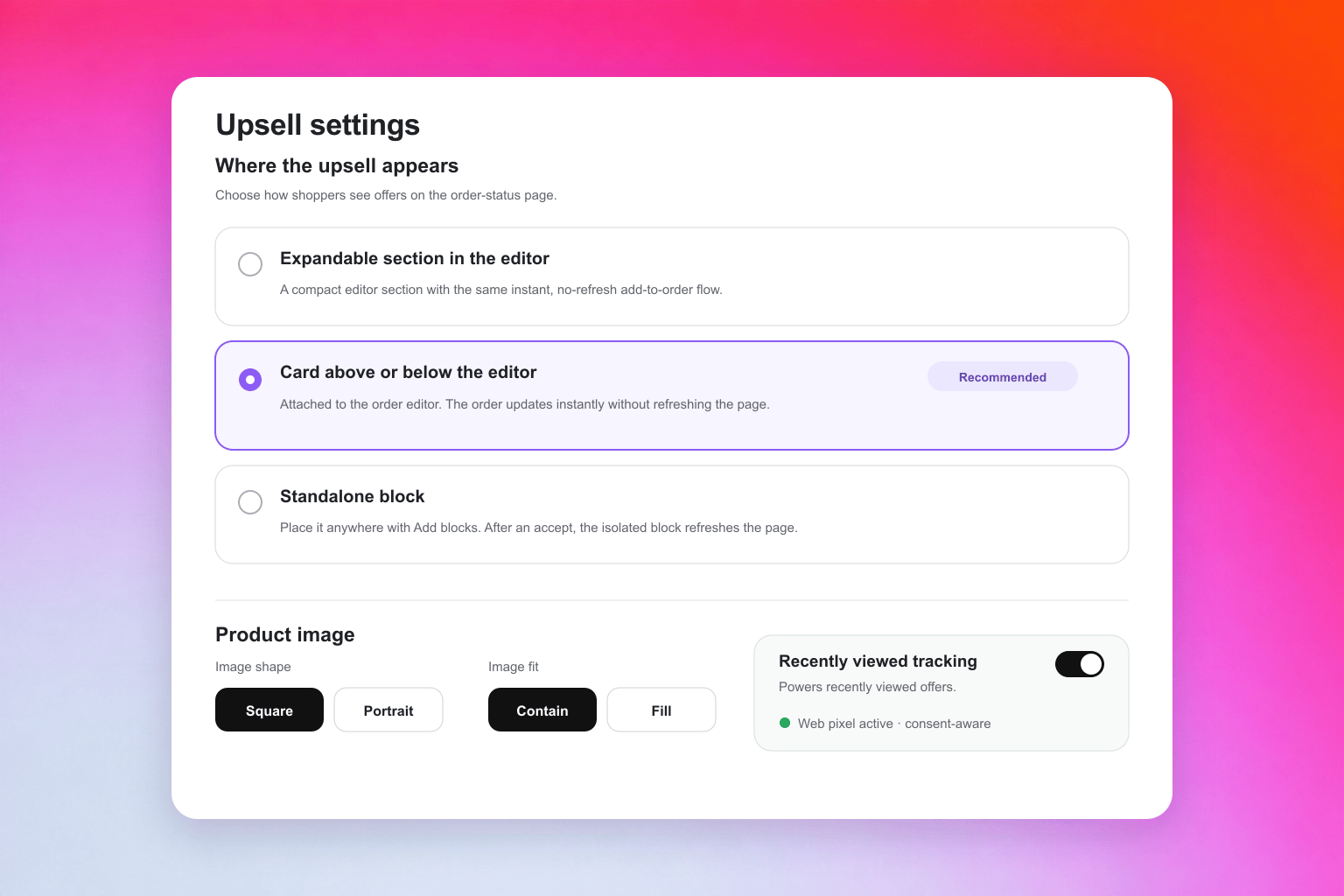
On the Order-status page, choose one of three placements. The placement changes both the layout and what happens after the customer accepts an offer.
Card above or below the editor (recommended)
Show the offer as a highlighted card attached to the Revize order editor. You can place it above or below the editor. Because it shares the editor’s add-product flow, the order updates instantly without refreshing the page.
Expandable section in the editor
Show the same editor-attached experience inside a compact Offers for you accordion. Customers expand the section and add a product without leaving or refreshing the page.
Standalone block
Add an isolated upsell block anywhere on the Order-status page through Shopify’s Add blocks editor. After a customer accepts an offer, this block refreshes the page so Shopify can load the updated order. That refresh is expected for the standalone surface.
The Thank-you page always uses the standalone block.
If you select Card above or below the editor or Expandable section, you do not need a separate Upsell app block on the Order-status page. The normal Revize Customer Portal block is enough. Add the separate block only for the Standalone block placement or the Thank-you page.
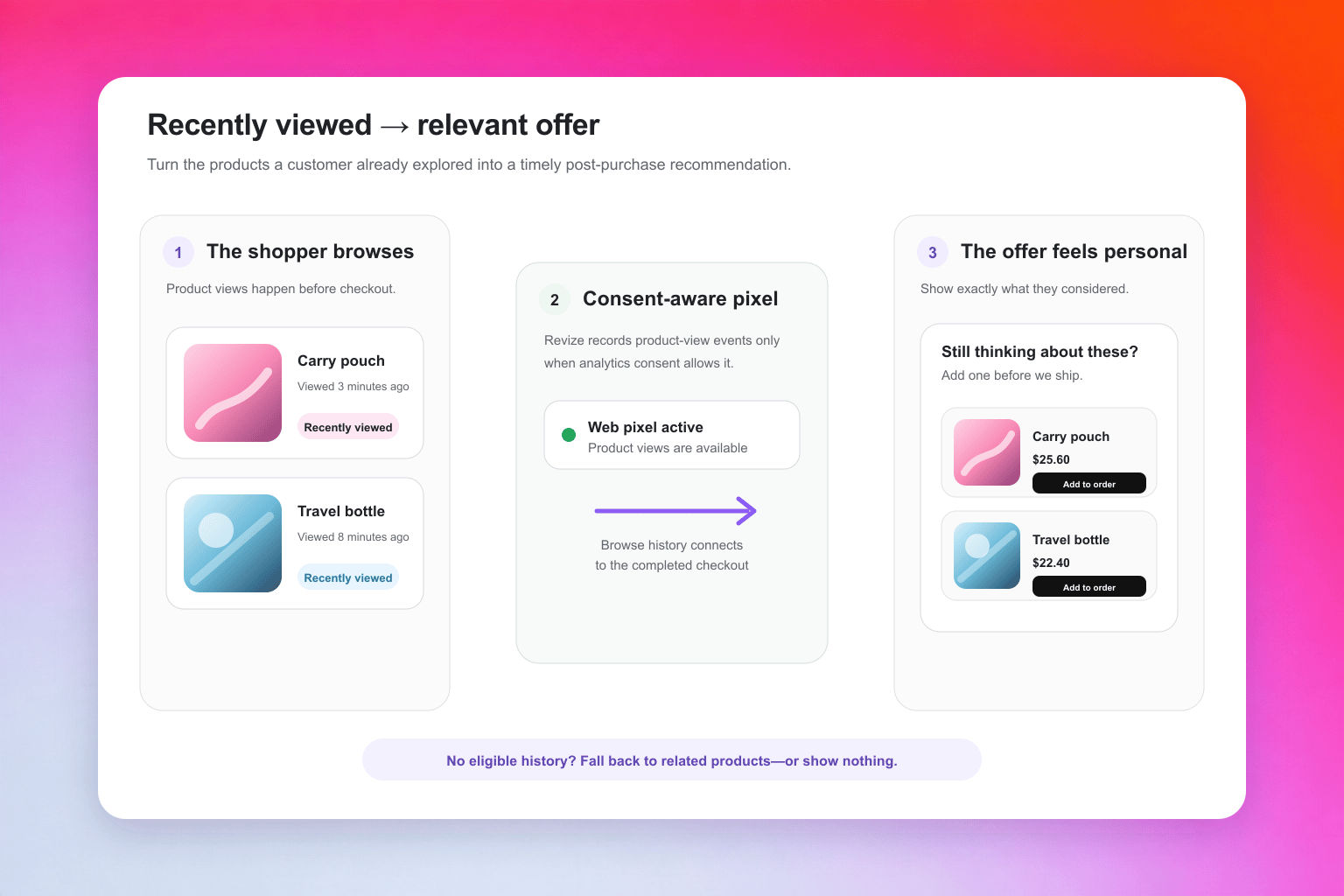
Recently viewed offers turn a shopper’s own browsing history into a highly relevant follow-up. Instead of showing a generic bestseller, Revize can surface the exact products the customer viewed but did not purchase while the original order is still open for editing.Open Upsell → Settings and enable Recently viewed tracking. Revize adds a lightweight Shopify web pixel that:
Records product-view events only when the customer’s analytics consent allows it
Connects that browsing session to the customer’s checkout
Makes eligible viewed products available to the Recently viewed source on the Thank-you and Order-status pages
This creates a natural second chance for products the customer was already considering, without requiring you to hand-pick recommendations for every order. If no eligible browse history is available, configure the offer to fall back to related products or show nothing.
Nothing is recorded until you enable the setting. The Upsell settings page also shows whether the web pixel is active.
See how many orders saw an offer, how many accepted, and the order-based conversion rate.
AOV uplift
Measure the change in average order value from paid upsells.
Per-offer performance
Compare individual offers and daily trends.
Top products
See the top five upsold products ranked by captured revenue.
Revenue counts only captured sales. An accepted offer that is never paid for, or an item that is removed before payment, contributes zero. Revize reconciles the result with Shopify before it appears as Upsell revenue.
Click Create offer, choose the surfaces, targeting, products, discount, design, countdown, and schedule.
3
Set the offer to Active
New offers are Draft. Change the status to Active, then save.
4
Check only the blocks your placement needs
Add the Revize Upsell block to the Thank-you page and to the Order-status page only when you selected Standalone block. For Card above or below the editor or Expandable section, the normal Revize Customer Portal block is enough. Do not add a second Upsell block.
5
Place a test order
Open the Thank-you and Order-status pages, confirm the right offer appears, add a product, and complete the Shopify payment flow.
Start with one broad offer and a real order-editing deadline. Once you have conversion data, add more specific offers above it for VIPs, high-value orders, or particular products.
No. Revize adds the product to the customer’s existing Shopify order through order editing.
Where does the customer pay?
Shopify handles the additional payment. After Revize adds the item, the customer reviews the updated order and pays the recalculated amount through Shopify.
What happens if the customer adds a product but never pays?
The added item stays on fulfillment hold and does not count as captured Upsell revenue. Enable Reverse Unpaid Edits under Settings → General when you want unpaid changes rolled back automatically after a grace window.
Can several offers be active at once?
Yes. Revize checks active offers in priority order and shows the first one whose conditions match. Drag offers to change their priority.
Can customers accept an offer more than once?
You decide per offer. Choose Unlimited or Once per order under Advanced.
Are the offers translated?
Built-in default copy is translated automatically. Custom Heading, Subheading, and Button text can be translated per offer from Translations.
Does the countdown create fake urgency?
The recommended mode counts down to the real order-editing deadline. A custom countdown is also capped by that deadline, so it never claims the offer lasts longer than the order can actually be edited.
Which plan includes Upsell offers?
Upsell offers are available on the Pro plan. The customer-initiated Add products experience remains part of the Revize order-editing portal.